
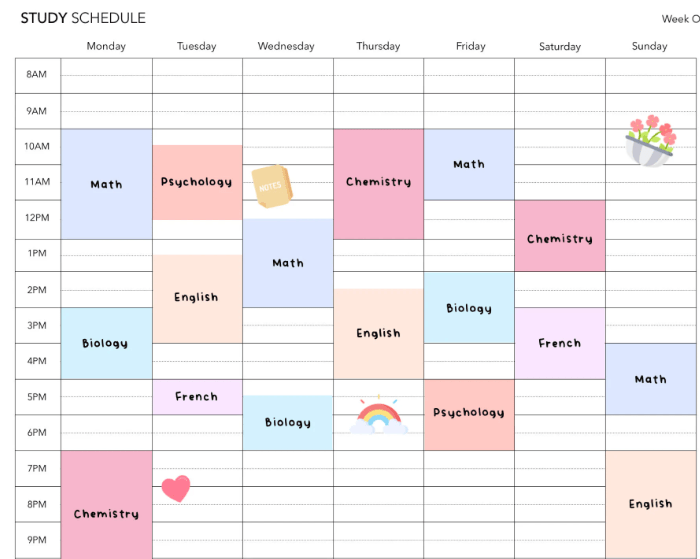
All schools use timetables to schedule their lessons and this is also the case for Bexley primary schools, state secondary schools and grammar schools (as well as Kent grammar schools).
But what about at home? Should your child have a study timetable? And is using a timetable at home especially important for pupils due to sit 11 plus exams trying to get into a grammar school?
A 2015 study by the University of Oxford found that students who followed a structured study schedule scored 15-20% higher on exams compared to those who studied irregularly. There’s no reason to suggest Year 5 children will not benefit in the same way, but even if those exact percentages do not translate onto Year 5 children, even a 5-10% improvement in performance is worthwhile. And it’s not just the University of Oxford that says a structured timetable helps performance. The National Survey of Student Engagement (NSSE) in the USA has found students who planned their study time were 2.5 times more likely to achieve higher grades. This is interesting as it goes some way to showing the universal benefits of using study timetables.
One problem we have noticed with pupils working towards the 11+ exam is that pupils quite often forget something they had previously learnt. This is understandable: many pupils start their 11+ journey at the beginning of Year 4, and by the time they get close to the 11+ exam, almost two years have passed. Interestingly, research from the Educational Testing Service (ETS) shows that spaced repetition (a key benefit of timetabling) improves retention rates by up to 50% compared to cramming. Similarly, The Pew Research Center (2021) found that 78% of high-achieving students attributed their success to consistent, scheduled study habits.
Also, research amongst students at university in the USA has shown there is a link between using study timetables and reducing stress and anxiety. The American Psychological Association (APA) reports that 61% of college students cite poor time management as a major source of stress. However, those who used study timetables reported 30% lower stress levels. Similarly, a 2020 study by the University of California, Los Angeles (UCLA) found that students with a fixed study routine were 40% less likely to procrastinate.
The research cited above seems convincing, but the studies are not directly linked to the 11 plus context, which is important to consider. A Year 5 child, for example, is at a different stage developmentally than a student at university. Also, university students may be juggling part time work alongside their studies, so a 10 year old and a 19 year old cannot be directly compared. Having said that, both types of students share some important similarities. Both are under a lot of pressure to perform. In the 11 plus context, gaining a place in a grammar school is incredibly competitive. In Bexley for example, out of the 6,000+ pupils that sit the 11+ test, around 800 pupils are given a place. Therefore parents of 11 plus-sitting pupils tend to go the extra mile to give their children every possible chance of getting a place at a grammar school.
Setting up a study timetable is an easy win. Once a study timetable is in place, it takes some time getting used to it. Your child may not be on board with the idea straight away, so you may need to spend some time (and energy) getting your child onboard with the idea. But once the study timetable is in full motion, it will make life a lot easier for parents, help improve performances for children and help them to remember what they learn for longer.
Parents are welcome to head to the free downloads page and download a study timetable to get started.
 Grammar School Pathway