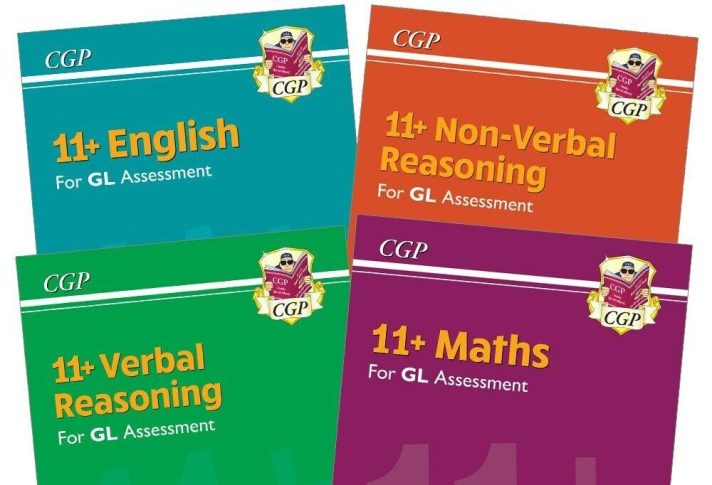
Most parents aiming to get their children into a grammar school have probably looked into physical 11+ books or 11+ digital resources . And parents might have noticed 11+ books usually have the terms ‘for GL assessment’, or ‘for CEM assessment’ or some other similar wording.
But what do terms such as GL, CEM, SET, CSSE mean?
They are names of exam boards specific to assessing 11 plus examinations. There are different exam boards, each favoured by a different school or council.
1. GL Assessment (Granada Learning)
If you’re hoping to get your child into a Bexley grammar school or a Kent grammar school, your child will need to sit the GL 11+ exam paper.
The subjects the GL exam assesses include English, Maths, Verbal Reasoning, and Non-Verbal Reasoning. Some schools, however, may drop one subject.
The exam usually consists of two papers, each about 50 minutes long. The exam is always multiple-choice format.
2. CEM (Centre for Evaluation & Monitoring (now part of Cambridge Assessment))
Bexley council used to use the CEM exam board until a few years ago. It’s less common now in the south east of England, but many councils still use it.
The CEM assesses Verbal Reasoning (vocabulary, comprehension), Numerical Reasoning (maths, problem-solving) and Non-Verbal Reasoning.
Children often find the CEM exam difficult. It uses fewer questions, but each question is quite complex (often includes short-answer and multiple-choice questions)
3. SET (Selective Eligibility Test – Used in Essex)
The SET is considered more comprehensive than GL and even the CEM exam. It is used across Essex grammar schools to help decide entry into Chelmsford County High and Colchester County High, amongst others.
The SET tests pupils on Maths and English (including comprehension and creative writing).
The test is a standard format (not multiple-choice). Those who pass sit a second-stage exam (usually set by the individual school).
4. CSSE (Consortium of Selective Schools in Essex)
As the name suggests, the CSSE is exclusive to Essex grammar schools. This includes Southend and Colchester Grammar School.
The CSEE tests pupils on English (comprehension, creative writing, grammar) and Maths (problem-solving, arithmetic).
The exam format consists of one combined paper (no multiple-choice) with a writing task.
Key Differences between Exam Boards
| Feature | GL Assessment | CEM | SET/CSSE (Essex) | Bucks Test | Sutton SET |
| Format | Multiple-choice | Mixed (MC + short answer) | Written answers | Multiple-choice | Written + MC |
| Subjects | English, Maths, VR, NVR | Mixed VR, NR, NVR | English & Maths | VR, NVR, NR | English, Maths, VR/NVR |
| Time Pressure | Moderate | High | Moderate | Moderate | High |
| Creative Writing | Rare | Rare | Yes (CSSE) | No | Yes (Second stage) |
Which Exam Board is Used Where?
- Kent & Bexley: GL Assessment
- Essex: SET (for some schools), CSSE (for others)
- Buckinghamshire: Own GL-style test
- Sutton: SET (first stage), then school-specific
- Surrey & Berkshire: Some GL, some CEM
Looking for downloadable resources? Head to our downloads page.
 Grammar School Pathway