‘VR’ stands for verbal reasoning. The topic is called verbal reasoning because it tests a student’s ability to understand, analyse and logically solve problems using words and language, rather than just relying on learned knowledge. The ‘verbal’ part refers to the use of words, and reasoning refers to the process of using logic and critical thinking to work through those words and find patterns or solutions. There is also another type of VR, which is number-based, but this is discussed in another article.
Children that read regularly, and therefore have a better vocabulary, tend to do well in word-based VR topics. There are many reasons for this and it is hugely beneficial for to the child.
- Speed
Children that have been exposed to a large range of words are able to quickly recognise words. In the context of the 11+ exam, being able to answer all questions within the allocated time increases the chances of passing the 11+ test.
- Word family familiarity
Oftentimes, a child may not know a particular word, but they may know another word from the same word family. An example will help illustrate this: consider the word ‘adhere’. From the word ‘adhere’, the following words can be derived:
- Adhesive
- Adhesion
- Adherence
- Adherent
Continuing with the above theme, consider this sentence:
The police sergeant’s own adherence to the law he was enforcing on others was questionable.
In this context, suppose a child did not know the word “adherence”, but knew the word ‘adhere’, the child would probably be able to decipher the meaning of the sentence.
The VR exam paper may have questions that use words a child does not directly know, but if they know a similar word from the word family, they may be able to pick up marks.
- Synonyms
A lot of the VR questions are asked in the context of synonyms or similar words. Pupils who read regularly are likely to know many synonyms for a single word. Let’s look at another example; take the word ‘big’. Something can be described as big using many different words, such as gigantic, gargantuan, humongous and monumental. In fact, there are around 100 alternative ways to say something is big. Those pupils who read regularly are likely to know many synonyms to a given word, which helps with many VR questions.
The main thing to understand about word-based VR is that it is based on word manipulation: something is done to the original word to get to the second word.
There are different types of VR questions that exist. Let’s take a look at one type below:
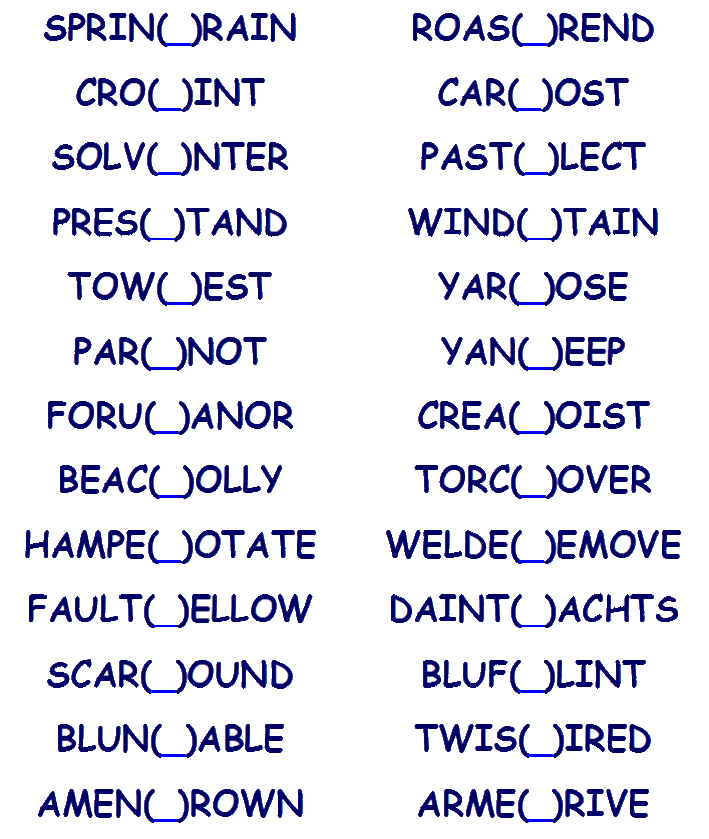
The aim of this task is to insert a letter into the bracket, and once inserted, it should create an independent word to the left of the bracket and a separate, independent word to the right of the bracket. Whatever letter you use for the words on the left, you have to use the same letter for the words on the right.
In the first line, we see SPRIN( )RAIN. If we put the letter ‘T’ inside the bracket, it will make ‘sprint’ to the left of the bracket and ‘train’ on the right of the bracket. To be sure, you can try another letter that might work to test it. For example, if we put a ‘’G’ in the bracket, it makes ‘spring’ to the left of the bracket, which works, and also makes ‘grain’ to the right of the bracket. So a ‘T’’ or a ‘G’ works for the first pair of words. The next pair of words are ROAS( )REND. If we put a ‘T’ in the bracket, it makes ‘roast’ and ‘trend’, which works. But if we put a ‘G’, we get ‘roasg’ and ‘grend’, which obviously does not work. Therefore, the correct answer is ‘T’.
Children that are regular readers will be able to figure out the answer very quickly, whereas non-readers may need to do some trial and error with different letters to reach the correct answer. In an exam, this eats up valuable time. As with every subject in the 11+ curriculum, practice is key.
Looking for downloadable resources? Head to our downloads page.
 Grammar School Pathway