When pupils begin their 11+ journey, the biggest shock to them is probably the difficulty level. 11+ work is not at the same level as children’s KS2 work they do in school; typically, the work is at least one level/ year above the level of work a child is doing at school. For pupils hoping to get into very selective schools, such as St Olave’s, the work is closer to two years above the level of KS2 school work. This is undoubtedly one of the biggest differences.
The second biggest difference is perhaps 11 plus mock exams, which all pupils who are serious about getting into grammar schools need to do regularly.
Familiarity
Pupils may be used to doing tests at school. Indeed, it is not uncommon for pupils to be tested at the end of a unit, term or academic year. However, children in British schools generally do not sit multiple-choice exams. This is more common in North America, but it is the primary way 11+ exams are conducted. All Bexley, Kent and Medway 11+ exams are conducted via multiple-choice exams.
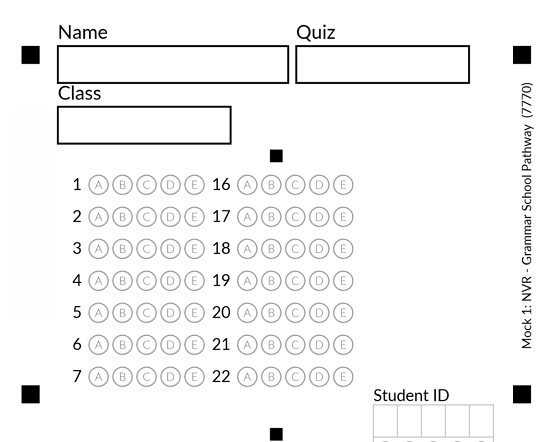
It is quite common for pupils to score poorly in the first 11+ mock they sit. This is to be expected. It can take some getting used to before pupils can quickly answer questions on the answer sheet, which involves shading a box/ circle using a pencil. Since the real 11+ exam is sat as a multiple-choice format exam, mock exams should also be in the multiple-choice format so it is as realistic as possible.
Frequency
Mock testing needs to be routine and regular.
Parents can set the interval, but it should be a regular occurence. For example, some parents may go for monthly mocks, whilst others may opt for a mock exam at the end of a topic. Both approaches are fine, as long as it is regular.
Setting
In addition to sitting mocks at home, some parents have found it useful to book mock tests at external centres. Children sometimes perform differently in different contexts. For example, children may score higher sitting a mock test in the comfort of their own homes, but in an external setting, the scores may not be as high.
We would advise mock tests be done externally.
Mock exam analysis
It’s important to analyse the answers and work through the mistakes.
This is a huge opportunity to identify and close gaps, and not anaylising results and answers is a lost opportunity.
Final thoughts
There are both pros and cons to using the multiple-choice format. In terms of speed, sometimes it is possible to eliminate three incorrect answers in a matter of seconds leaving only the correct answer even without doing any calculation. This, of course, saves precious time in an exam. On the flip side, if pupils get into a habit of trying to eliminate incorrect answers using their estimation skills, it may reduce their ability to calculate answers. So a mix of multiple choice answers and calcuation answers should be used.
Almost all 11 plus books and other resources ask questions and then offer the possible answers in a multiple-choice format. If pupils are not already using the multiple choice answer sheet, it may be a good idea to start using them. However, not all resources provide multiple-answer sheets. Parents are welcome to download a multiple-choice answer sheet from our downloads page to help their child on the 11+ journey.
Looking for downloadable resources? Head to our downloads page.
 Grammar School Pathway