
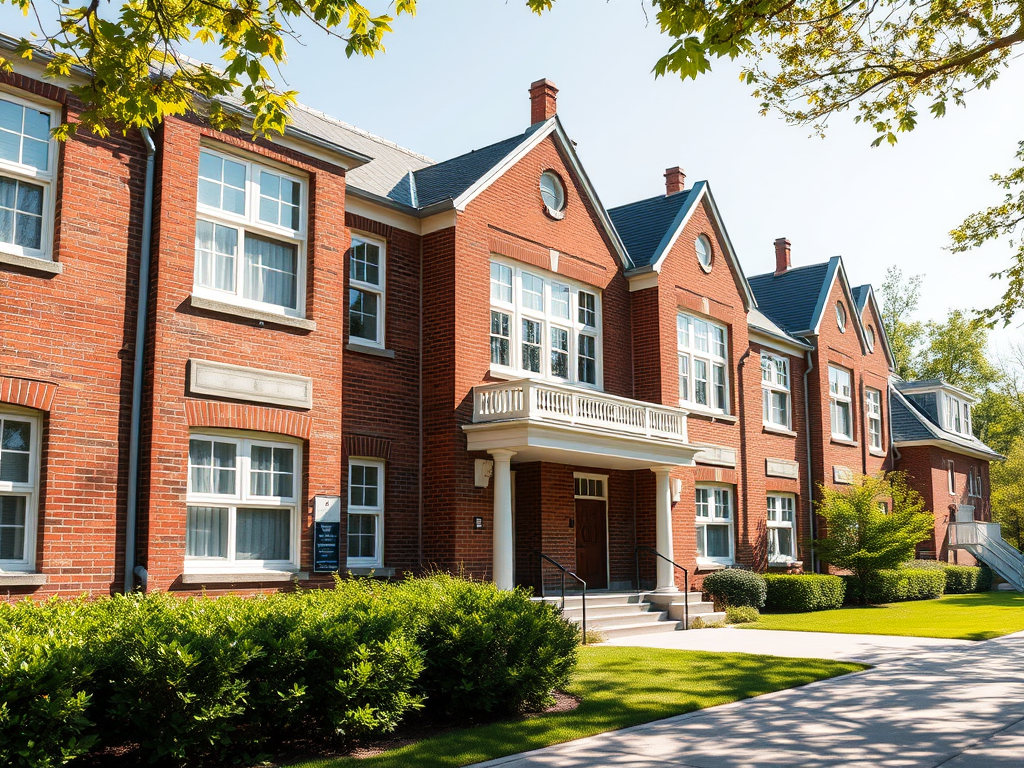
In the UK education system, a ‘grammar school’ is a selective state-funded secondary school. Selection is based on pupils’ academic ability and entry is determined by a competitive exam, commonly known as the ’11 plus’, which children usually sit in their final year of primary school (Year 6). Pupils are typically tested on English, Maths, VR and NVR. The goal of grammar schools is to provide a rigorous, academically focused education for pupils who excel in an exam-based environment. It’s important to note that grammar schools are only found in certain parts of England and Northern Ireland; Scotland and Wales no longer have them. Even in England, grammar schools are quite rare compared to comprehensive state schools. Using London as an example, there are around 550 state comprehensive schools, but only around 20 grammar schools, which means competition for places is fierce.
In what ways are grammar schools similar or different from state comprehensive schools?
There are many similarities between state comprehensive schools and grammar schools and also some differences, too.
Curriculum:
The curriculum is pretty similar in both grammar schools and state comprehensive schools. Schools take guidance from the Department for Education in terms of what the curriculum should look like. Whilst individual schools may interpret how best to deliver the curriculum slightly differently, the bulk of the curriculum will be very similar.
For Key Stage 4 and 5, it may very well be identical. This is because at KS4 and KS5, exam boards decide what topics will be examined. This means schools (state comprehensives and grammars) must teach whatever the exam board will test pupils on. If a state comprehensive school and a grammar school happen to use the same text book as the primary resource and source of information, there may be little to no difference in terms of the curriculum content delivery.
Teaching:
Grammar Schools aim to recruit teachers that possess an undergraduate degree (e.g. English BA) as well as a PGCE (or equivalent), which can be thought of as a ‘teacher’s degree’. Anything beyond this is not necessary, but some staff may possess more advanced qualifications, such as a PhD.
State comprehensive schools aim to recruit the same calibre of teacher since the requirement is the same.
So in this regard, the teaching aspect is not automatically better in a grammar school.
Trips:
Trips are becoming increasingly rare in state comprehensive schools. The cost of coach hire alone is making some trips prohibitively expensive. In some schools, only the essential trip has survived (e.g. Geography fieldtrip).
In state comprehensive schools that still run trips, international trips are not too common. The cost for parents is very high and often too much for the average parent to bear.
In grammar schools, international trips are commonplace and the schools expect parents to find the money to cover the costs. It’s true that some parents of grammar school children are wealthy, but this is definitely not the case with many parents.
Extracurricular:
This is the area where big differences can be seen. Grammar schools tend to offer more extracurricular clubs. These clubs are not necessarily linked to an academic subject, but instead, may aim to develop a different aspect of a pupil.
State comprehensive schools may very well spend the same amount of time and effort on after-school activities, but quite often this is focused on things like catch-up classes, etc. This is not to say state comprehensive schools do not offer non-academic extracurricular activities – they do. But the variety, scope and frequency is likely to be less.
Behaviour:
This is by far the area with the biggest difference. Pupils in grammar schools rarely misbehave.
This means that if a lesson is 60 minutes long, close to 60 minutes of learning will actually take place. In state comprehensive schools, sadly, in a 60 minute lesson sometimes up to half a lesson can be wasted unnecessarily due to high and low level disruption.
Pupil background:
The overwhelming majority of grammar school pupils are going to be from families who are professionals. For example, their parents will hold formal and advanced qualifications and work in respectable industries, such as medicine and education. These parents oftentimes will themselves be alumni of grammar schools and therefore know the rigour involved in getting into, and studying at, a grammar school.
Pupil expectation:
The expectations that parents and teachers have of grammar school pupils are very high. This high expectation feeds into the children themselves. Quite often, grammar school pupils will not be upset because they have failed something (this is rare in the first place), but because they did not score the highest mark in class.
Uniform:
Most schools in the UK require students to wear a uniform. However, it is rare for state comprehensive schools to ask parents to get personalised uniform items. It is common, however, for grammar schools to ask parents to get PE kits embroidered in with the child’s name as well as other items of kit and clothing, such as a lab coat or goggles.
How can I apply to get my child into a grammar school?
Grammar schools are not available everywhere. They exist in just a few local authorities in England, such as Kent, Bexley and Medway as well as in Northern Ireland. The application process is two-fold.
First, your child must register for and sit the 11 plus exam, often through the school or a consortium of local grammar schools.
Second, you must list your preferred grammar schools on the local authority’s common application form, just as you would for any other secondary school. In the event that a high 11-plus score does not guarantee a place, catchment areas and other criteria may play a role in the decision to offer a grammar school place.
The 11 plus entrance exam
The 11 plus exam is the single most important factor for entry. It is designed to test a child’s academic potential and is typically taken around the age of 10 or 11. The exam usually covers four key areas: English (comprehension & writing, and sometimes creative writing), Mathematics, Verbal Reasoning (problem-solving with words and concepts), and Non-Verbal Reasoning (problem-solving with diagrams and shapes). The specific format and content can vary by region, so it is crucial to check with the grammar schools you are interested in or your local authority for precise details.
Is a grammar school the right choice for your child?
This is the most important question. Consider your child’s personality and academic strengths. Do they thrive under pressure and enjoy academic challenges? The environment is highly competitive and the workload is demanding. It is also essential to think about the practicalities: the travel time, the potential need for tutoring, and what your back-up options would be if they do not secure a place. As part of your research, try to engage with the schools you are considering; attend their open days, speak to parents, and if possible, speak to students too.
Looking for downloadable resources? Head to our downloads page.
 Grammar School Pathway